
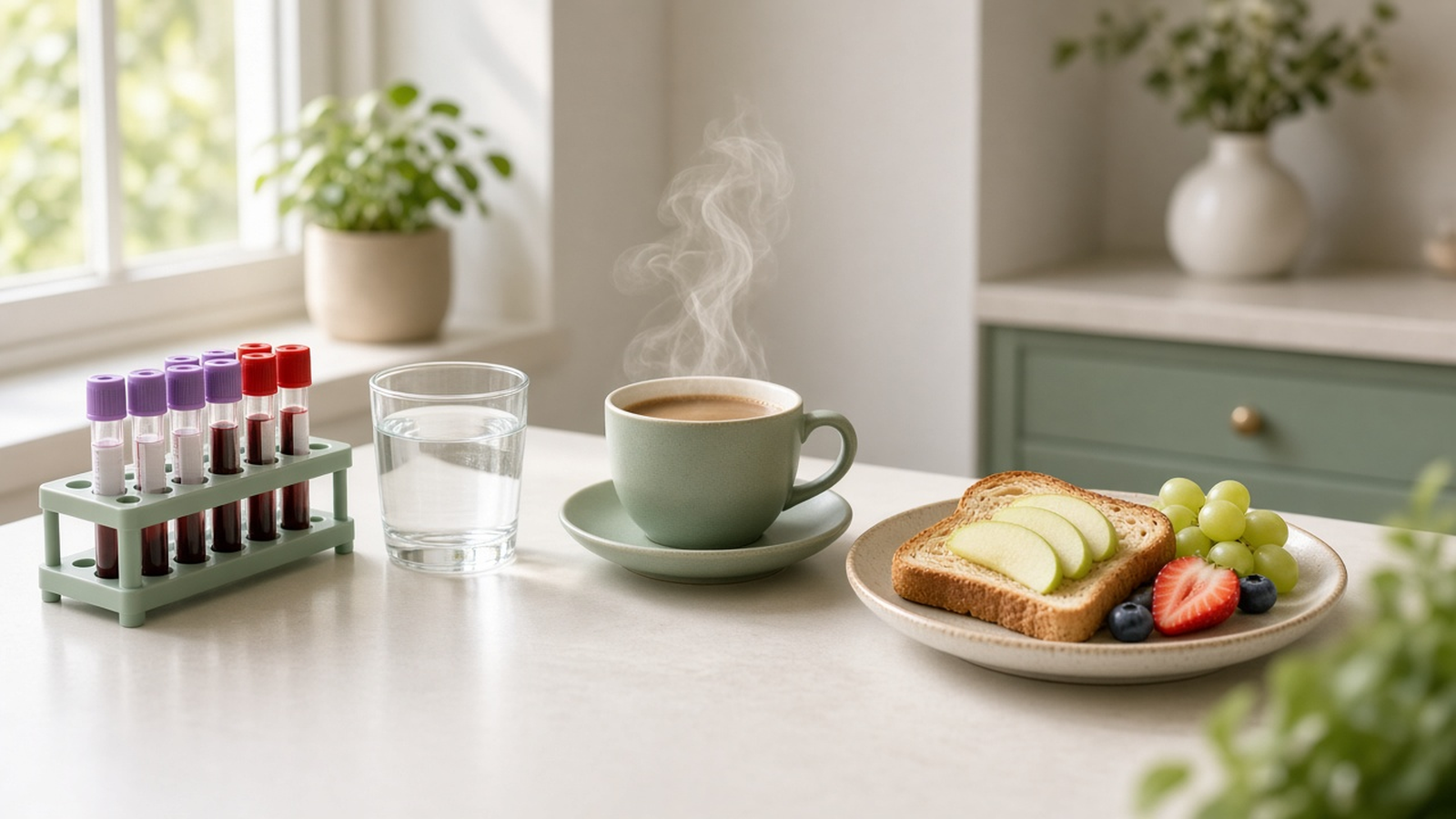
Do You Really Need to Fast Before Blood Work? Usually Not, and Here's When You Do
November 5, 2026 · David Alonso, MD
For most routine blood tests, fasting makes little difference. Here's when it still matters for blood sugar and cholesterol, and what you can drink while fasting.
"Do I need to fast for this?" might be the single most common question my staff gets the day before a blood draw. For decades, the default answer was yes: nothing after midnight, show up hungry, hope the lab line is short. Plenty of my patients have spent a long morning lightheaded and grumpy, waiting for coffee.
A large new study gives us a better answer, and for most people it's good news. For most routine blood tests, fasting makes little to no difference. For a handful of tests it does matter, and longer is not better. Here's what that means for you.
What the new study looked at
Researchers in South Korea, publishing in JAMA Internal Medicine this fall, analyzed about 9.8 million lab results from more than 101,000 adult outpatients at one university hospital. They grouped results by how long people had gone without eating: less than 8 hours, 8 to 12 hours, or more than 12 hours.
Importantly, they didn't just compare different groups of people. They also compared the same patients against themselves on different visits, which helps separate a real fasting effect from differences between the kinds of people who show up fasting versus not. They then asked a practical question: is the difference big enough to matter, compared with the normal error and day-to-day variation labs already accept?
What they found
- Of 121 routine tests, 27 looked different by fasting status at first glance. But when the same people were compared with themselves, only 10 held up.
- The clearest effects were for glucose (about 11 percent higher with less than 8 hours of fasting), triglycerides (about 20 percent higher), GGT, a liver enzyme (about 15 percent higher), and lipase, a pancreas enzyme (about 36 percent higher).
- The complete blood count, electrolytes, and most kidney, liver, and cholesterol measures showed little meaningful change.
- Fasting more than 12 hours added nothing. No test differed meaningfully between the 8-to-12-hour group and the more-than-12-hour group.
The authors' conclusion was sensible: fasting rules should be test-specific, not one-size-fits-all.
Where I part ways with the cholesterol guidelines
Here, respectfully, I take a slightly different view from the major guidelines. A 2016 joint statement from European atherosclerosis and laboratory medicine societies recommended non-fasting lipid panels as the routine default. They found that after a typical meal, LDL cholesterol shifts by only about 8 mg/dL and triglycerides rise by about 26 mg/dL, and that HDL, apoB, and Lp(a) aren't affected by eating at all.
The 2018 American Heart Association and American College of Cardiology cholesterol guideline followed suit: a fasting or non-fasting panel is acceptable for estimating heart risk and getting a baseline LDL, and a non-fasting triglyceride level of 400 mg/dL or higher should be repeated fasting. The reasoning is sound and well intentioned. Skipping the fast makes testing more convenient, and more people get checked.
I understand that goal, but I think it trades away some accuracy. The new study confirms that triglycerides run higher when you haven't fasted, and in my clinical judgment triglycerides are an important part of the lipid profile, even if the guidelines tend to give them less weight. LDL shifts too. About 8 mg/dL is small, but it is still a difference. When I'm assessing someone's cardiovascular risk, I want the most accurate numbers I can get, so I still prefer a fasting lipid panel.
When fasting still matters
Most routine tests, such as blood counts, kidney and liver tests, and electrolytes, don't need fasting. In my practice, I encourage patients to fast about 8 hours for two kinds of testing:
- When we're assessing blood sugar or diabetes risk with a metabolic panel. (A hemoglobin A1c reflects your average blood sugar over the past few months, so it doesn't require fasting.)
- When we're assessing cardiovascular risk with a lipid panel, so your triglycerides and LDL are as accurate as possible.
And always follow your lab order if it specifically says to fast. Some specialized tests have their own rules, so follow what's on the paperwork.
What I tell patients in practice
Water is fine while fasting, and I encourage it, since staying hydrated makes the draw easier. Black coffee is also okay and shouldn't affect the readings. If you take insulin or certain other diabetes medicines, ask us ahead of time how to handle a fasting draw so your blood sugar doesn't drop too low.
I'm also honest about the limits of the new data. It comes from a single hospital system in Korea, it's observational rather than a randomized trial, and diets differ around the world. But it lines up with years of earlier research, and it's genuinely good news: for most routine blood work, you can skip the fast.
Practical takeaways
- Routine blood work, such as a CBC, kidney and liver tests, and electrolytes, doesn't require fasting.
- For blood sugar testing and lipid (cholesterol) panels, I ask patients to fast about 8 hours. Going 12 or more hours doesn't make results more accurate.
- Water is fine and encouraged, and black coffee is okay.
- Take your usual medications unless we've told you otherwise. If you use insulin or other diabetes medicines, ask us how to handle a fasting draw so your sugar doesn't drop.
- When in doubt, call us. A quick question beats a wasted trip or a repeat draw.
This post is for general education and is not personal medical advice. Please talk with your own clinician about what preparation your specific tests need.
Sources
- https://jamanetwork.com/journals/jamainternalmedicine/fullarticle/2854601
- https://pmc.ncbi.nlm.nih.gov/articles/PMC4929379/
- https://www.jacc.org/doi/10.1016/j.jacc.2018.11.003