
Losing Weight on a GLP-1? Here's How to Keep Your Muscle
November 2, 2026 · David Alonso, MD
Most weight lost on GLP-1 medicines is fat, but muscle matters too. Here's what the research shows and the practical steps that help you keep your muscle.
One of the most common questions I hear from patients starting semaglutide (Wegovy, Ozempic) or tirzepatide (Zepbound, Mounjaro) is some version of: "Am I going to lose muscle?" It's a fair worry. These medications are some of the most effective tools we've ever had for weight and metabolic health, and I'm genuinely excited about what they do for my patients. But how you lose weight matters, not just how much. The good news is that muscle loss is largely something you can influence, and the steps are simple.
What actually happens to your body composition
When anyone loses a meaningful amount of weight, whether by diet, surgery, or medication, some of that loss is "lean mass," not fat. Lean mass includes muscle, but also water, organs, and other non-fat tissue, so it isn't the same thing as muscle alone.
Here is what the big trials found when they measured body composition with DXA scans (the gold standard):
- In the tirzepatide SURMOUNT-1 trial, people lost about 21% of their body weight. Roughly 74% of that was fat and 26% was lean mass. Visceral fat, the dangerous fat around the organs, dropped by about 40%. (Look et al., 2025)
- In the semaglutide STEP-1 trial, about 60% of weight lost was fat and 40% was lean mass. (Expert review)
- A 2026 meta-analysis of 20 randomized trials found lean mass made up about 25% to 39% of weight lost on these drugs, which is broadly similar to what happens with intensive diet and lifestyle programs (about 26%). When lifestyle programs added resistance training, the lean share dropped to about 17.5%. (Meta-analysis, 2026)
Where the headlines outrun the data
You may have seen claims that GLP-1s "melt your muscle." That overstates it. Most of the weight lost is fat, and the proportion of lean loss looks about the same as with any other way of losing weight. These drugs are simply very good at producing a lot of weight loss, so the absolute amount of lean tissue lost can be bigger.
That said, it's not nothing. One expert review estimated that the muscle lost over 68 to 72 weeks in the pivotal trials may be roughly comparable to what many adults lose over a couple of decades of normal aging. That's an estimate, not a direct measurement, but it's a good reason to be intentional. It matters most for people over 60, people who already have low muscle, and anyone with frailty or bone loss.
What we don't yet know well is how much this lean loss affects strength, function, and long-term health for the average patient. The honest summary: it's worth protecting your muscle, and the tools to do it are well established.
How I help patients protect their muscle
In my practice, I treat a GLP-1 prescription as a package deal: the medication plus a plan for protein and strength. A 2025 joint advisory from four major nutrition and obesity medicine societies backs this approach. (Joint advisory, 2025)
Lift something, at least three times a week
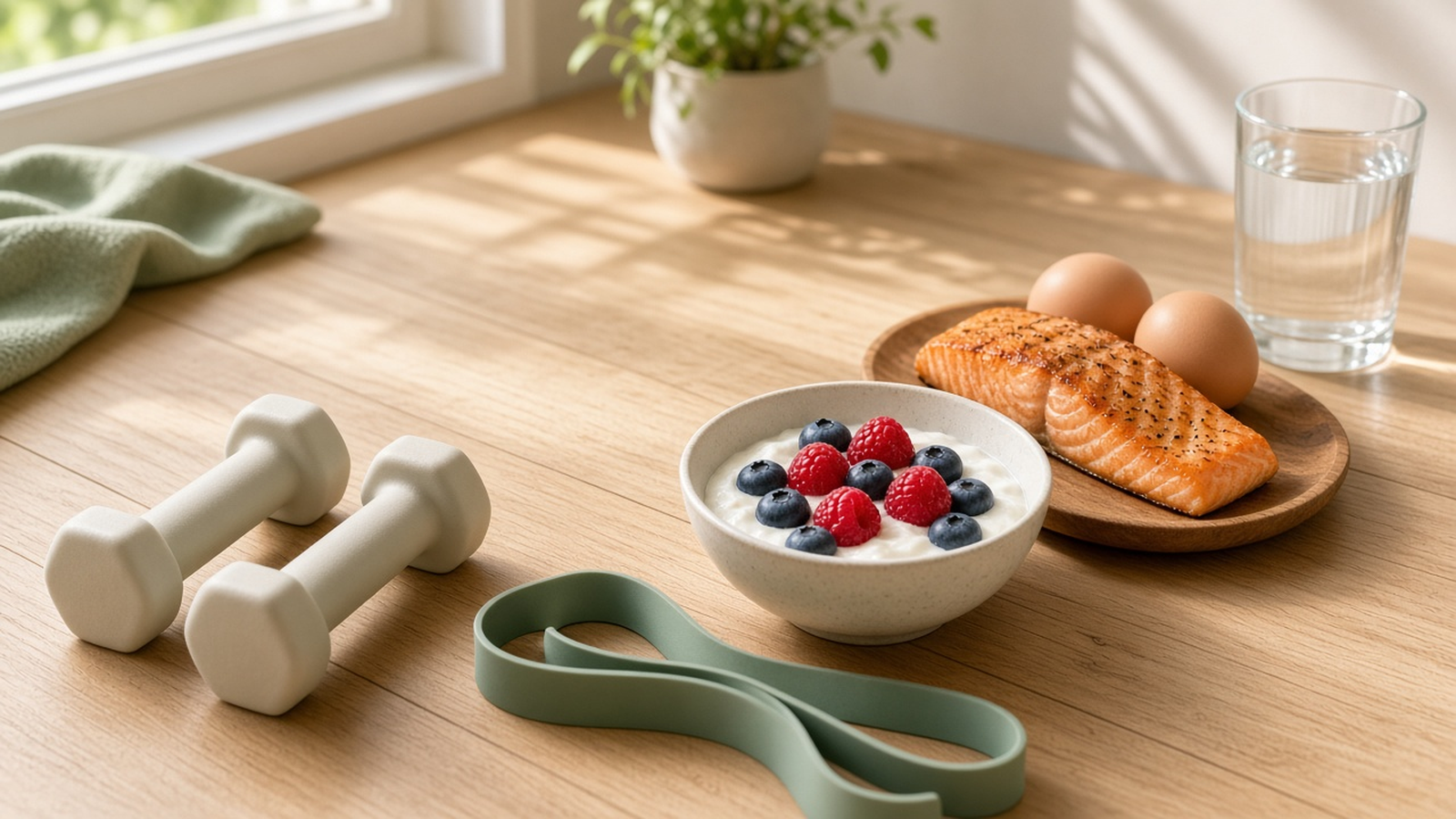
This is the single most important step. The advisory recommends strength training at least three times weekly plus at least 150 minutes of moderate aerobic activity, such as brisk walking. Protein alone is not enough to preserve muscle without resistance training. Resistance bands, body-weight exercises, machines, or free weights all count. Start where you are and build gradually.
Prioritize protein, even when you're not hungry
GLP-1s turn down appetite, which is the point, but it's easy to under-eat protein. The advisory suggests a practical target of about 80 to 120 grams of protein a day for most people, or roughly 1.2 to 1.6 grams per kilogram during active weight loss (your clinician may adjust this based on your size and kidney health). Tips that work for my patients:
- Eat your protein first at each meal.
- Spread it out, aiming for 25 to 40 grams per meal.
- Lean on easy options: Greek yogurt, cottage cheese, eggs, fish, chicken, tofu, beans, or a protein shake when appetite is very low.
Don't forget fiber, fluids, and micronutrients
Eating less overall can leave gaps. Vegetables, fruit, whole grains, and enough water help with both nutrition and the constipation that can come with these medications.
Lose weight at a steady pace
In my experience, patients who lose very fast while barely eating are the ones who feel weak and depleted. If you're losing quickly and feeling weak, tell your clinician. Slowing the dose increases is often reasonable.
Track more than the scale
The scale can't tell fat from muscle. Simple checks help: Is your grip getting weaker? Is it harder to climb stairs or get up from a chair? Is your waist shrinking? In some patients, I'll check body composition at baseline and along the way, which the advisory also encourages.
Tools we add in our office
Beyond the basics above, here are two things we've added in my own practice. They aren't part of the standard guidance most of the medical community follows, but they've been valuable for many of my patients.
- Muscle-stimulating treatments. We use HIFEM technology (high-intensity focused electromagnetic therapy), which triggers strong muscle contractions, as another tool to help preserve and even build muscle. It has also been shown to reduce some visceral fat on its own. It complements strength training rather than replacing it, and it's especially useful for people who can't exercise regularly, for example because of an old injury.
- Hormone optimization. For the right patients, appropriate hormone optimization, such as testosterone, can further help preserve or even increase muscle during a weight-loss journey. I've seen this in many of my patients. It always starts with a careful evaluation and lab work.
A brief word on what's coming
Researchers are studying drugs designed to help preserve muscle during GLP-1 treatment. It's early, and none are ready for routine use. For now, strength training and protein remain the proven, low-cost tools, and they work.
Practical takeaways
- Most weight lost on GLP-1 medications is fat, including the harmful visceral fat. Lean loss happens, but at a rate similar to other weight-loss methods.
- Strength training at least three times a week is the most powerful way to protect your muscle. Start small and be consistent.
- Aim for roughly 80 to 120 grams of protein daily, eaten first at meals and spread through the day.
- Add about 150 minutes a week of walking or other moderate activity.
- In our office, muscle-stimulating treatments and, for the right patients, hormone optimization can add another layer of support.
- Watch for signs of weakness, and ask about body composition checks if you're older or have low muscle or bone density.
- Think of your GLP-1 as a powerful tool that works best with a plan. You're not just losing weight; you're building a healthier, stronger body.
This article is for general education and isn't personal medical advice. Please talk with your own clinician before starting or changing any medication, diet, or exercise program.
Sources
- https://pmc.ncbi.nlm.nih.gov/articles/PMC11965027/
- https://pmc.ncbi.nlm.nih.gov/articles/PMC11611443/
- https://pubmed.ncbi.nlm.nih.gov/41877354/
- https://pmc.ncbi.nlm.nih.gov/articles/PMC12304835/