
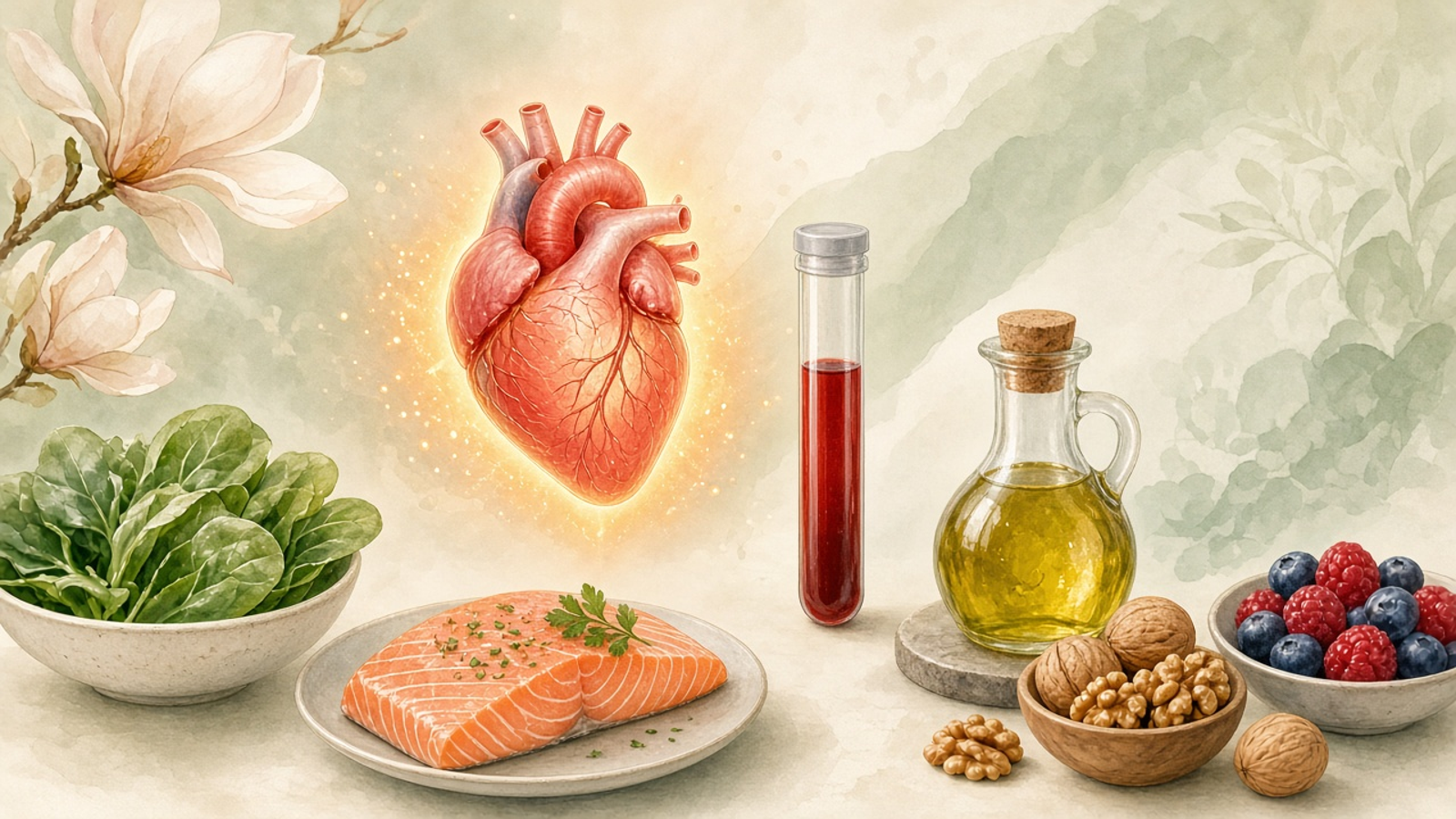
Inflammation and Your Heart: The Blood Test Worth Asking About
November 20, 2026 · David Alonso, MD
A simple, inexpensive blood test called hs-CRP measures inflammation, a key driver of heart attacks and strokes. Here's what your number means and how to bring it down.
Most of us know our cholesterol numbers. Far fewer people know about a simple, inexpensive blood test that measures something just as important for heart health: inflammation.
It's called high-sensitivity C-reactive protein, or hs-CRP. In 2025 the American College of Cardiology recommended checking it in everyone being evaluated for heart disease risk, right alongside cholesterol. Cardiologists are talking about it again this month, so here's a plain-language guide to what it is, what your number means, and what to do about it.
What is hs-CRP?
C-reactive protein is made by your liver when there's inflammation in the body. A regular CRP test picks up big spikes, like during an infection. The high-sensitivity version measures much lower levels, the kind of quiet, low-grade inflammation that can simmer for years.
That matters because heart attacks and strokes aren't just a plumbing problem of cholesterol building up in arteries. Inflammation helps plaque grow and makes it more likely to crack open and form a clot. Cholesterol is the fuel; inflammation is often the spark.
Why doctors are paying attention now
The evidence has been building for decades:
- In the JUPITER trial, about 17,800 healthy adults with normal LDL cholesterol but an hs-CRP of 2 or higher took either a statin or a placebo. The statin group had 44% fewer heart attacks, strokes, and related events. These were people many of us would have told "your cholesterol is fine."
- In the Women's Health Study, which followed nearly 28,000 initially healthy women for 30 years, a single hs-CRP test predicted heart attacks and strokes decades later. Women in the highest group had about 70% higher risk than those in the lowest, and the risk was highest in women who also had high LDL and high Lp(a).
- In people who already have heart disease, the ACC says hs-CRP predicts future events at least as well as LDL cholesterol, even while they're on a statin.
The ACC put it simply: clinicians won't treat what they don't measure.
What your number means
Results are reported in mg/L. For heart risk, the American Heart Association uses these ranges:
- Under 1: lower risk
- 1 to 3: average risk
- Over 3: higher risk
- Over 10: usually means something else is going on, like an infection, injury, or flare of arthritis. We repeat it once you've recovered.
A few things to keep in mind. hs-CRP doesn't tell us where the inflammation is coming from, and it can bounce around with a cold, a hard workout, or a dental problem. That's why one high result isn't a diagnosis. If it's elevated, I usually recheck it a few weeks later when you're feeling well. Current cholesterol guidelines count an hs-CRP of 2 or higher as a "risk enhancer," which can tip the decision toward treatment when someone is on the fence. The good news is that no fasting is needed for this one.
What actually lowers inflammation
This is the hopeful part. hs-CRP is one of the most changeable numbers on your lab report.
- Lose excess weight, especially belly fat. Fat around the organs is an active source of inflammation, and weight loss is one of the most reliable ways to bring hs-CRP down.
- Move regularly. Both aerobic exercise and strength training help.
- Stop smoking. Inflammation starts to fall soon after quitting.
- Eat fish, olive oil, nuts, and fiber, and less processed food and added sugar.
- Treat sleep apnea, gum disease, and other chronic inflammatory conditions.
- Statins lower hs-CRP as well as LDL. For people whose hs-CRP stays high, the ACC says a statin is worth considering even when LDL looks normal.
- For people who already have heart disease, a low-dose colchicine tablet is now FDA-approved to reduce heart attacks and strokes. It's the first anti-inflammatory medicine approved for this, though it isn't right for everyone, especially people with kidney or liver problems or on certain medicines.
In my own practice, I find hs-CRP a useful conversation starter. When patients see their number come down after a few months of weight loss, exercise, or treatment, it's real motivation, and it tells us both that the changes are working beneath the surface.
Where the hype outruns the data
hs-CRP is a strong risk marker, but it isn't a crystal ball. It works best as one piece of the picture, alongside blood pressure, cholesterol, Lp(a), blood sugar, family history, and sometimes a coronary calcium scan. Lowering inflammation through healthy habits clearly helps, but we don't have evidence that "anti-inflammatory" supplements lower heart risk. And several anti-inflammatory drugs studied for heart disease didn't pan out, so more research is still needed before newer options are widely used.
Practical takeaways
- Ask for hs-CRP the next time you get your cholesterol checked. It's an inexpensive blood test and no fasting is required.
- Get tested when you're well, not during a cold or flare.
- If your result is over 3, don't panic. Recheck it, then use it as motivation.
- If it stays high, talk with your doctor about your overall heart risk and whether a statin makes sense, even if your LDL is normal.
- Focus on what moves the number: weight, exercise, not smoking, diet, and sleep.
- If you already have heart disease and your hs-CRP is above 2, ask whether your treatment can be stepped up.
This post is for general education and is not personal medical advice. Please talk with your own healthcare provider about your situation.
Sources
- https://www.jacc.org/doi/10.1016/j.jacc.2025.08.047
- https://www.acpjournals.org/doi/10.7326/acpi-20250930_1
- https://www.acc.org/latest-in-cardiology/articles/2025/12/01/01/prioritizing-health-hscrp
- https://professional.heart.org/en/-/media/PHD-Files/Education/hsCRP-Toolkit-for-Professionals.pdf
- https://www.nejm.org/doi/full/10.1056/NEJMoa0807646
- https://www.nejm.org/doi/full/10.1056/NEJMoa2405182
- https://www.nih.gov/news-events/news-releases/single-blood-test-predicts-30-year-cardiovascular-disease-risks-women
- https://www.accessdata.fda.gov/drugsatfda_docs/nda/2024/215727Orig1s000Approv.pdf